Graduation show Master Vacant NL reviewed by Tracy Metz

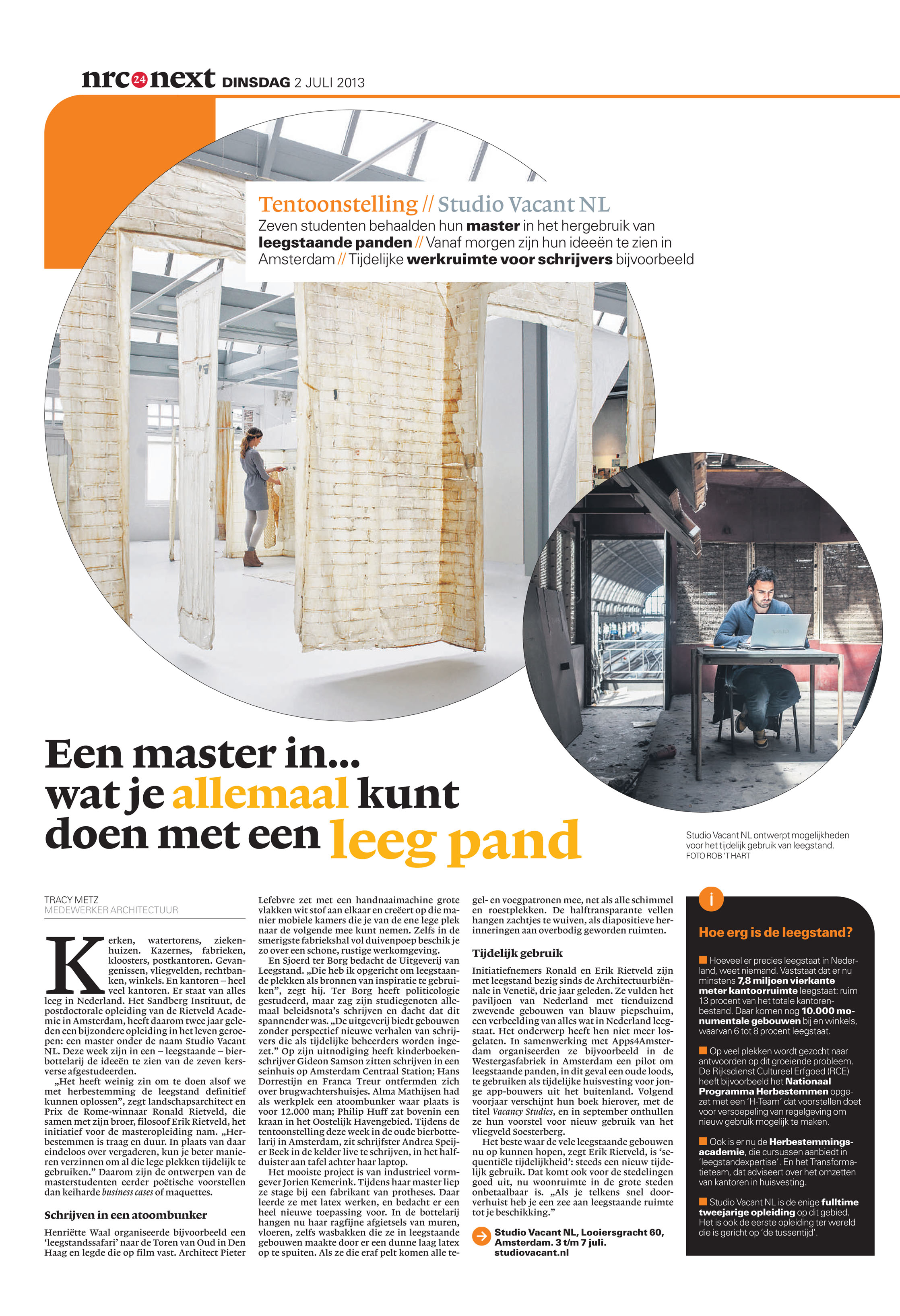
Tracy Metz (the architecture critic of the Netherlands national newspaper NRC Handelsblad/Next) reviewed the graduation exposition of our students at Sandberg Institute’s Master Vacant NL. This is the first program in the world that focuses on the potential of ”temporary use” of empty architecture. Working on-site, the graduates unlock the affordances of vacant building with novel interventions. Their projects present opportunities for sequential temporary use (hopping from building to building) and provide users with unorthodox tools to colonize vacant cultural heritage, thousands of unique, goverment-owned buildings. Read the review here (click to zoom in; the article is in Dutch).

See also a review (in Dutch) by journal de Architect.

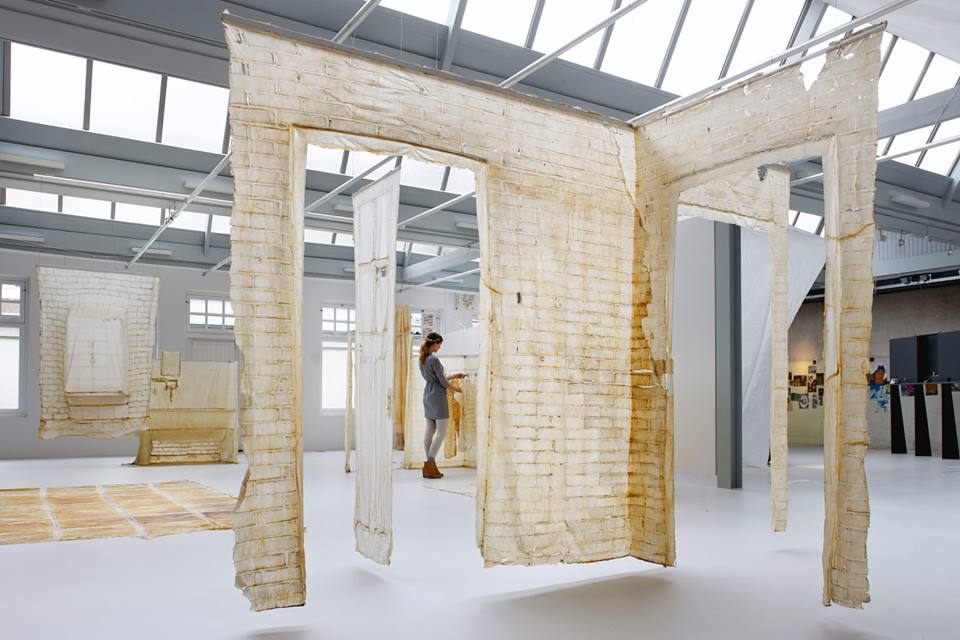
JorienSkinned2

Skinned by Jorien Kemerink at Looiersgracht 60, Amsterdam (photo: Rob ‘t Hart)

VIDI-grant awarded by Netherlands Organisation for Scientific Research (NWO)

Great news: Today I learned that I’ve been awarded a VIDI-grant! This means 5 years of fundamental research in philosophy and generous NWO-funding to develop my research group. Here is a short project description:

The Landscape of Affordances: Situating the Embodied Mind

In many situations, experts at work act successfully, yet without deliberation. Architects, for example, perceive immediately the opportunities offered by the site of a new project, and intuitively improve the size of the door in one of their designs. One could label these manifestations of expert intuition as ‘higher-level’ cognition, but still these experts are just acting unreflectively. Traditionally in philosophy, so-called ‘higher’ cognitive capacities are associated more with explicit deliberation and linguistic forms of rationality than with unreflective action, but this has left unexplained the characteristic phenomenon of intuitive expertise (e.g. intuitively improving a design).
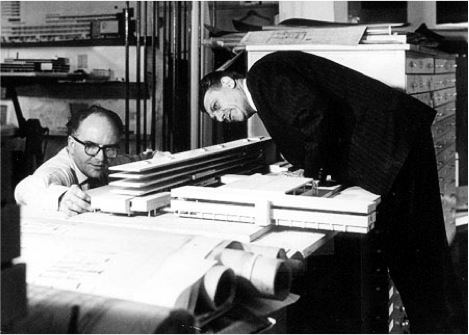
Bakema

The two central ideas behind this NWO VIDI-proposal are (a) that many of these context-sensitive episodes of ‘higher’ cognition can be understood along the same lines as everyday skillful unreflective activities, such as grasping a coffee cup or riding a bike; and (b) that our surroundings contribute to skillful action and cognition in a far more fundamental way than is generally acknowledged.

My long term aim is to use these ideas to develop a novel conceptual framework for embodied or ‘enactive’ cognitive science (Thompson, 2007; Chemero, 2009). The cognition we find in expert intuition is very context-sensitive because it consists of responsiveness to multiple possibilities for action provided by our surroundings, or ‘affordances’. I argue that the notion of affordances is rich in application, so it makes sense to say both that a cup affords grasping and that a friend’s sad face affords comforting. Moreover, we are bodily responsive to a multiplicity of affordances simultaneously (Rietveld, 2012a/b). Embodied cognition amounts here to skillful responsiveness to the many affordances available in one’s surroundings; a selective responsiveness to a whole field of affordances.

This integrative, philosophical framework is innovative in showing how the increasingly influential field of embodied cognitive science has a much wider scope than previously thought. Findings thought to be exclusively valid for everyday unreflective action (or for sensorimotor behavior) can now be applied to skilled ‘higher’ cognition, or better, expert intuition (project 1). We will also show concrete, real-world applications in the domains of architecture (project 2) and psychiatry (project 3 on Deep Brain Stimulation), respectively. Interactions with renowned experts in these practices feed the development of the overall framework. Another project (4) will advance convergence with Karl Friston’s influential work on the anticipating brain, by situating the latter in the whole system ‘brain-body-landscape of affordances’.

Read more: interview with SMART Cognitive Science

NWOlogoEN

Pretty Vacant

Below you will find a photo of Pretty Vacant, a new installation by Rietveld Landscape, acquired by the Centraal Museum with support of the Mondriaan Fund.

Pretty Vacant

The installation Pretty Vacant by design and research studio Rietveld Landscape encourages visitors to take a fresh look at the empty spaces of the Centraal Museum. The blue window literally and figuratively sheds a new light on the space and complements the architecture of this medieval chapel. The window is based on the ‘negative spaces’ of Rietveld Landscape’s earlier installation Vacant NL, which was the Dutch submission for the Venice Architecture Biennale in 2010.

 ArchitecturalReviewCoverVacantNL RestmateriaalVacantNL

The installation in the Gerrit Rietveld-designed pavilion in Venice showed the enormous potential of 10,000 disused public buildings in the Netherlands from the seventeenth to the twenty-first centuries.

From the press release of the Centraal Museum: “Rietveld Landscape’s work fits in well with the Centraal Museum aim to acquire work at the intersection of art, design and architecture. Rietveld Landscape is a young studio that represents in an outstanding way the new developments at this intersection. Museum Director Edwin Jacobs described them as ‘the talents in field of spatial interventions, without equivalent in any existing architectural or theoretical discourse. They are real new-thinkers in images.’ Through the acquisition of the installation Pretty Vacant by Rietveld Landscape with support from the Mondriaan Fund, the Centraal Museum has realised its ambition of adding Vacant NL to the ‘Collectie Nederland’.”

News Items: New Radicals

Last year in the UK, the Observer and the National Endowment for Science, Technology and the Arts joined forces to find 50 New Radicals. They selected “people who were coming up with creative answers to the big issues of our times”, according to newspaper the Guardian.

NewRadicalsVN2013

Yesterday this initiative got a follow-up in the Netherlands. My brother, Ronald, and I were selected by a jury chaired by Herman Wijffels as New Radicals because of our innovative interdisciplinary approach to architectural design, which also integrates insights from my work in the philosophy of enactive or embodied cognition. Just like the report of the Rotterdam Design Prize jury last year, this confirms the potential of translational embodied cognition and, more in particular, of the field of enactive architecture.

For more information see news item at Netherlands Organisation for Scientific Research (NWO)-website, here.

NWOlogoEN

Progress on plans for future research

I spent last summer writing two exciting new research proposals for fundamental work in philosophy of enactive/embodied cognition. These new ideas have been inspired by my experiences with embedded research in the worlds of architecture and psychiatry.

I have now been informed that my philosophical research proposals have been selected for the final rounds of both the ERC Starting Grant and NWO’s VIDI scheme for innovative research. The aim of these novels plans is showing how my understanding of embodied cognition as skillful responsiveness to the rich landscape of affordances offered by our surroundings opens up new perspectives for studying skillful ‘higher-level’ cognition and context-sensitivity, which are important open issues in enactive or embodied cognitive science. Central to the VIDI will be a new project on Deep Brain Stimulation and skilled intentionality.

Upcoming invited talks this spring 2013

I have been invited to present work at several interesting and recommended events in the field of enactive or embodied cogntive science this spring:

April 3-5, Methods in studying social cognition, Heinrich-Heine Universität, Düsseldorf

April 19, Enactive Architecture & Vacancy Studies, Architecture Academy, Amsterdam

April 22, End of year talk, Neurophenomenology & Architecture, University of Toronto

April 26, Merleau-Ponty Symposium (in Dutch), University of Amsterdam

May 6, Affordances & Sense of Space, Het Huis, Utrecht, organized by theater maker Boukje Schweigman.

June 6-7, Intersubjectivity as Interaction – In the footsteps of Merleau-Ponty, RU Nijmegen (read my abstract HyperAffordanceGrip here).

June 17-19, The Reach of Radical Embodied or Enactive Cognition, Antwerp Univerisity (contributed talk, read my abstract ‘Skilled Intentionality for “Higher” Cognition’ here).

MPInteractionNijmegen

Award and new publication

Last Friday the Dutch Psychiatry & Philosophy Foundation has awarded my chapter with a prize for the best contribution to the Dutch Handbook Psychiatry & Philosophy. In my opinion this award confirms the potential of the new field of translational embodied cognition.

Another chapter for a Cambridge University Press volume on Neuroscientific and Philosophical perspectives on Free Will has been accepted recently and is forthcoming:

De Haan, S, Rietveld, E. & Denys, D. (forthcoming), Being free by losing control: What Obsessive-Compulsive Disorder can tell us about free will. In Glannon, W. (ed.) Neuroscientific and Philosophical Perspectives on Free Will. Cambridge: Cambridge University Press.

Frontiers paper well read

Frontiers’ Journal Manager just wrote that our recent sketch on how the notion of a ‘landscape of affordances’ can help embodied cognitive science to deal with the difficult open issue of context-sensitivity is among their most downloaded articles. Download the PDF here:

Kiverstein, J. & Rietveld, E. (2012), Dealing with context through action-oriented predictive processingFrontiers in Theoretical and Philosophical Psychology 3 (421), pp. 1-2.

Rietveld Landscape on Frontiers: Industrial Jurassic

The image above shows how Rietveld Landscape deals with frontiers: the installation ‘Industrial Jurassic’ changes the local landscape of affordances temporarily, offering people the possibility to cross the border between Belgium and The Netherlands for one day.

Sydney research visit

This week I will be visiting the philosopher John Sutton and his interdisciplinary research group in Sydney to learn more about their work on distributed cognition in expert perfomance (in music, top sports, etc.). This is a preparation for a new embedded research project on distributed ‘higher’ cognition in architectural design.

Three new publications on enactive embodied cognition

Here are three important new publications showing the potential of understanding enactive or embodied cognition in terms of skillful responsiveness to a field of affordances or ‘skilled intentionality’. This series of papers shows how to think of this at the phenomenological, psychological, and neural levels of analysis, and, crucially, how my notion of ‘responsiveness to a field of affordances’ makes it possible to relate insights gained at these different levels.

Kiverstein, J. & Rietveld, E. (2012), Dealing with context through action-oriented predictive processing. Frontiers in Theoretical and Philosophical Psychology 3 (421), pp. 1-2.

Rietveld, E. (2012), Bodily intentionality and social affordances in context, in Paglieri, F. (ed.) Consciousness in Interaction. The Role of the Natural and Social Context in Shaping Consciousness. Amsterdam: J. Benjamins, pp. 207-226.

Rietveld, E., De Haan, S. & Denys, D (forthcoming), Social affordances in context: What is it that we are bodily responsive to? Invited commentary article on Leo Schilbach et al. BBS, Behavioral and Brain Sciences.